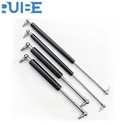
As a supplier of gas springs for chairs, ensuring the functionality and quality of our products is of utmost importance. Gas springs play a crucial role in the performance and comfort of chairs, and thorough testing is necessary to meet the high - standards expected by our customers. In this blog, I will share the comprehensive process I use to test the functionality of a new gas spring for a chair.
1. Initial Visual Inspection
Before any physical testing, a detailed visual inspection is conducted. I carefully examine the gas spring for any visible defects such as scratches, dents, or misalignments on the cylinder or piston rod. A damaged surface can lead to gas leakage over time, which will significantly affect the performance of the gas spring. Additionally, I check the quality of the end - fittings. They should be properly attached and have no signs of loose connections. Any imperfection at this stage may indicate potential problems during later use, so it is essential to identify and address these issues early on.
2. Measuring Basic Dimensions
Accurate dimensions are vital for the proper installation and functionality of the gas spring in a chair. I use precision measuring tools such as calipers and micrometers to measure the length, diameter of the cylinder, and the size of the end - fittings. These measurements are compared against the design specifications. Even a slight deviation in dimensions can cause problems during installation, such as the gas spring not fitting properly or not being able to provide the required support. For example, if the length is too short, the chair may not be able to achieve the desired range of motion.
3. Force Testing
One of the most critical aspects of a gas spring is its force characteristics. I use a force testing machine to measure the compression and extension forces of the gas spring. During compression testing, the gas spring is gradually compressed at a controlled rate, and the force required to compress it is recorded at different positions. Similarly, during extension testing, the force exerted by the gas spring as it extends is measured.
The measured forces should match the design values. If the compression force is too high, the chair may be difficult to adjust, while a too - low compression force may result in the chair not staying in the desired position. For a standard office chair, the compression force should be within a specific range to ensure smooth and easy adjustment for the user.
4. Stroke Testing
The stroke of a gas spring refers to the distance it can extend and compress. I perform stroke testing by mounting the gas spring on a test fixture and manually moving it through its full range of motion multiple times. I use a displacement sensor to accurately measure the stroke length. The stroke should be consistent with the design requirements. Inconsistent stroke lengths can lead to problems such as the chair not fully reclining or not returning to an upright position properly.
5. Leakage Testing
Gas leakage is a major concern for gas springs. To detect any potential leaks, I use a pressure decay test. The gas spring is first pressurized to the normal operating pressure and then isolated from the pressure source. The pressure inside the gas spring is monitored over a period of time. If there is a significant drop in pressure, it indicates a gas leak.
Another method is the soap bubble test. I apply a soapy solution to the joints and seals of the gas spring. If there is a leak, bubbles will form at the location of the leak. Gas leakage can reduce the performance of the gas spring over time and may even lead to complete failure.
6. Fatigue Testing
A gas spring in a chair is subjected to repeated use over its lifespan. To simulate real - world usage, I conduct fatigue testing. The gas spring is mounted on a test rig and cycled through a large number of compression and extension cycles, typically tens of thousands of times. During the test, the force and stroke are monitored regularly. Any significant changes in these parameters may indicate fatigue - related problems such as gas leakage, loss of force, or damage to the internal components.
7. Temperature Testing
The performance of a gas spring can be affected by temperature changes. I conduct temperature testing in a climate - controlled chamber. The gas spring is tested at different temperatures, ranging from low temperatures (e.g., - 20°C) to high temperatures (e.g., 60°C). At each temperature, the force and stroke are measured. This helps to ensure that the gas spring can perform reliably in different environmental conditions. For example, in a cold environment, the gas inside the spring may contract, affecting the force characteristics.
8. Durability Testing
In addition to fatigue testing, durability testing assesses the overall long - term performance of the gas spring. This includes exposing the gas spring to various environmental factors such as humidity, dust, and vibration. The gas spring is placed in a test chamber where it is subjected to a combination of these factors for an extended period. After the test, the gas spring is inspected for any signs of corrosion, wear, or damage.
9. Compatibility Testing
Since gas springs are used in different types of chairs, compatibility testing is essential. I test the gas spring on different chair models to ensure that it works well with various chair designs. This includes checking the installation process, the range of motion, and the overall comfort provided by the chair. For example, a gas spring designed for a massage chair may have different requirements compared to one for an office chair. You can learn more about our Massage Chair Lockable Gas Spring on our website.
10. Noise Testing
A quiet operation is important for a gas spring in a chair. I conduct noise testing in a sound - proof chamber. The gas spring is cycled through its range of motion, and any noise generated during compression and extension is recorded. Excessive noise can be a sign of internal problems such as friction between components or gas leakage. A noisy gas spring can be a nuisance to the user, especially in a quiet environment like an office.
Conclusion
Testing the functionality of a new gas spring for a chair is a comprehensive process that involves multiple steps. From visual inspection to complex performance testing, each step is crucial to ensure that the gas spring meets the highest quality standards. By conducting these tests, we can provide our customers with reliable and high - performance gas springs.


If you are in the market for high - quality gas springs for chairs, whether it's for office chairs, Gas Struts for Medical Bed, or Sofa Gas Spring, we are here to meet your needs. We invite you to contact us for more information and to discuss your specific requirements. Our team of experts is ready to assist you in finding the perfect gas spring solution for your chairs.
References
- "Engineering Handbook of Gas Springs" by Suspa Inc.
- "Mechanical Design of Machine Elements and Machines: A Failure - Prevention Perspective" by Robert C. Juvinall and Kurt M. Marshek.
- Industry standards and guidelines related to gas springs for chairs.